
Generative Engine Optimisation (GEO): The Complete 2026 Authority Guide
- Home
- Generative Engine Optimisation (GEO): The Complete 2026 Authority Guide
Generative Engine Optimisation (GEO): The Complete 2026 Authority Guide
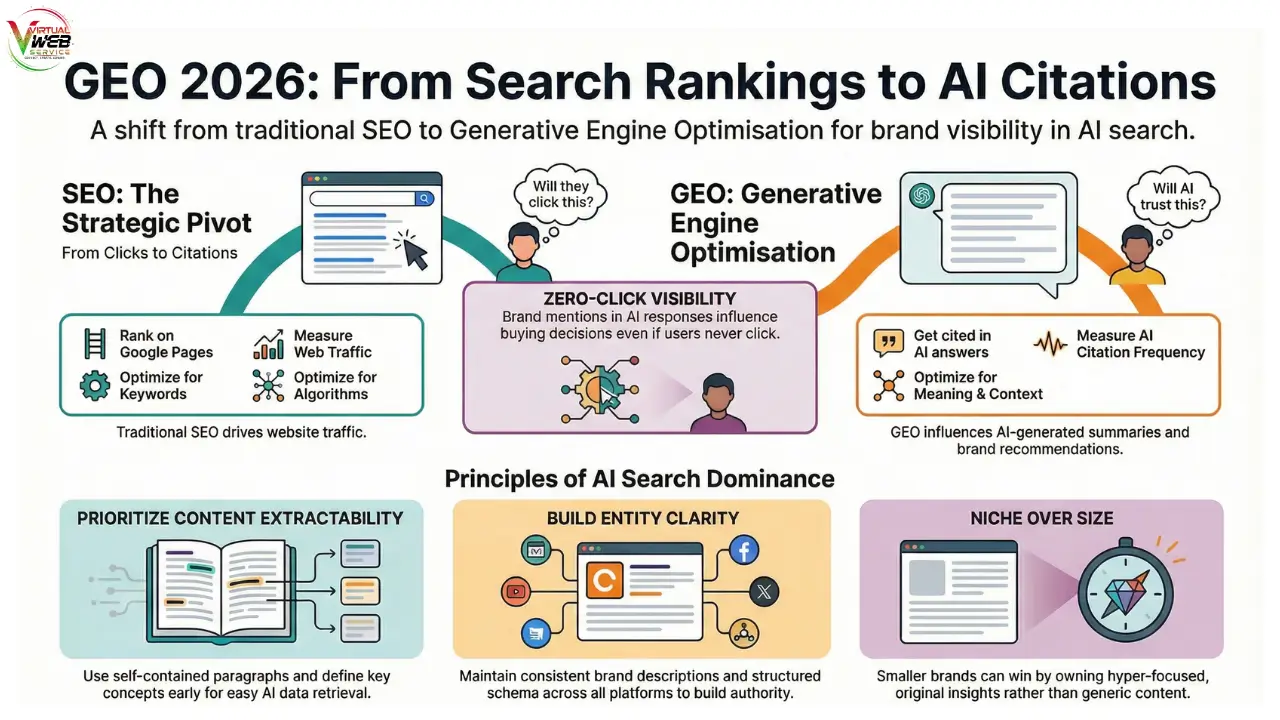
Search is no longer just about ranking on Google.
It’s about being selected, summarized, and recommended by AI systems.
Generative Engine Optimisation (GEO) is the strategy that makes that happen.
If SEO helped users find websites, GEO helps AI engines find trusted answers.
In this in-depth guide, you’ll learn:
What Generative Engine Optimisation really is
How GEO differs from SEO
How AI engines choose which brands to mention
Actionable GEO strategies you can implement today
How to measure AI visibility
Common mistakes to avoid
A practical framework to dominate AI search in 2026
What Is Generative Engine Optimisation (GEO)?
Generative Engine Optimisation (GEO) is the process of optimizing your content, brand signals, and digital presence so AI-powered search systems can understand, trust, and reference your brand when generating answers.
Unlike traditional SEO, which focuses on ranking web pages, GEO focuses on being:
Cited
Mentioned
Recommended
Summarized
Used as a source inside AI-generated responses
Generative engines don’t just rank links.
They synthesize information from multiple sources to produce direct answers.
If your brand isn’t structurally clear, authoritative, and extractable, it won’t be included.
Why Generative Engine Optimisation Matters in 2026
Search behavior has fundamentally changed.
AI tools like:
ChatGPT
Google Gemini
Perplexity AI
are now answering questions directly.
Users increasingly:
Ask AI before searching Google
Make decisions from summaries
Compare products via conversational AI
Trust AI-generated recommendations
This means:
✔ Users may never click your website
✔ AI may shape perception before traffic happens
✔ Brand mentions now influence buying decisions
Visibility is no longer just about clicks.
It’s about being part of the answer.
How Generative Engines Actually Choose Sources
AI systems don’t pick content randomly.
They evaluate content based on:
1. Entity Clarity
Is your brand clearly defined?
Does AI understand who you are and what you do?
2. Content Extractability
Can individual paragraphs stand alone?
Are definitions clear and self-contained?
3. Consistency Across Platforms
Does your website description match your LinkedIn profile?
Do reviews support your positioning?
4. Structured Signals
Are headings clear?
Is schema implemented correctly?
5. Repeated Authority Signals
Do multiple sources confirm your expertise?
AI doesn’t reward keyword stuffing.
It rewards clarity and coherence.
Generative Engine Optimisation vs SEO
Both strategies matter. But they optimize for different outcomes.
| Traditional SEO | Generative Engine Optimisation |
|---|---|
| Rank on Google | Get cited in AI answers |
| Drive clicks | Influence summaries |
| Optimize keywords | Optimize meaning |
| Measure traffic | Measure AI mentions |
| Compete per page | Compete at brand level |
SEO asks: Will someone click this?
GEO asks: Will AI trust this enough to reuse it?
You need both.
The 5 Core Principles of Generative Engine Optimisation
1. Strong SEO Fundamentals Are Still Required
Technical accessibility matters.
Fast load speed
Clean HTML structure
Mobile responsiveness
Crawlable content
Minimal heavy JavaScript
AI engines still retrieve content from indexed sources.
If your technical SEO is broken, GEO fails.
2. Entity Clarity Defines AI Understanding
AI needs to understand:
Your brand name
Your category
Your services
Your expertise area
Your location (if relevant)
You must:
Use consistent brand descriptions
Implement structured data (JSON-LD)
Clarify services clearly on service pages
Avoid vague positioning
Ambiguity reduces AI confidence.
3. Content Must Be Self-Contained and Extractable
Generative engines retrieve content in chunks.
Weak paragraph:
There are several reasons this works. Many people find it helpful.
Strong paragraph:
Generative Engine Optimisation improves AI visibility by structuring content into self-contained, clearly defined explanations that AI systems can extract and reuse accurately.
Every key section should:
Define one idea
Use precise language
Avoid “this” and “that” without context
Include facts and clarity
4. GEO Extends Beyond Your Website
AI systems pull data from:
Reddit discussions
YouTube videos
Industry publications
Review platforms
Business directories
Social media
You need:
Owned Presence
Thought leadership posts
Educational YouTube content
LinkedIn expertise articles
Detailed guides
Earned Mentions
Reviews
Press mentions
Community discussions
Expert roundups
The more consistent your brand narrative across platforms, the higher AI confidence.
5. GEO Requires New Metrics
Traditional SEO metrics are incomplete.
Track:
AI citation frequency
AI share of voice
Mention sentiment
Prompt-based visibility
Brand inclusion rate in AI responses
Traffic alone does not measure AI visibility.
Actionable Generative Engine Optimisation Strategies
Here’s how to implement GEO today.
1. Structure Content Around Questions
Use H2 and H3 headers like:
What is Generative Engine Optimisation?
How does GEO differ from SEO?
Why does GEO matter for businesses?
Direct question-based headings improve AI extraction.
2. Define Key Concepts Early
Place definitions at the top of sections.
AI often extracts the first strong explanation it finds.
3. Build Topic Clusters
Instead of one blog post, create:
Ultimate guides
Case studies
Comparison articles
FAQs
Industry insights
Depth increases authority probability.
4. Strengthen Brand Signals
Ensure:
Your About page clearly defines expertise
Author bios highlight credentials
Service pages are specific
Testimonials include detailed context
External citations reinforce positioning
5. Use Structured Data Properly
Implement:
Organization schema
Article schema
FAQ schema
Service schema
Product schema (if applicable)
Schema doesn’t guarantee mentions, but it improves clarity.
Common Generative Engine Optimisation Mistakes
Avoid these:
❌ Publishing mass generic AI content
❌ Thin pages without depth
❌ Keyword stuffing
❌ Inconsistent brand positioning
❌ Ignoring technical SEO
❌ Chasing AI trends without strategy
GEO is not a hack.
It is a discipline.
How Small and Mid-Sized Brands Can Win in GEO
Large brands have authority.
But smaller brands can win by:
Owning niche expertise
Creating hyper-focused content
Maintaining structural clarity
Building strong entity signals
Publishing original insights
AI systems reward clarity over size.
Niche dominance often beats generic authority.
The Future of Generative Engine Optimisation
In 2026 and beyond:
AI Overviews will expand
Conversational commerce will grow
Zero-click searches will increase
AI referral traffic will become measurable
Brand mentions will shape purchase decisions
GEO is not replacing SEO.
It is expanding it.
Search is evolving from:
“Find a website”
to
“Get a trusted answer.”
Frequently Asked Questions About Generative Engine Optimisation
Is Generative Engine Optimisation replacing SEO?
No. GEO builds on SEO fundamentals but optimizes for AI citations instead of just rankings.
How do I measure GEO success?
Track AI mentions, share of voice, sentiment, and referral patterns from AI platforms.
Does schema guarantee AI mentions?
No. But it improves content clarity and entity definition.
Can small businesses compete in GEO?
Yes. Clear niche authority and structured content can outperform larger brands.
Is AI visibility stable?
AI outputs fluctuate, but authority patterns remain consistent.
Final Takeaway
Generative Engine Optimisation is about one core principle:
Earning trust at scale in machine-mediated search.
When AI systems increasingly speak on behalf of brands,
being trusted by those systems becomes a strategic advantage.
The brands that win in 2026 will:
Publish fewer, higher-quality pieces
Prioritize clarity over volume
Strengthen entity consistency
Build multi-platform authority
Measure AI visibility alongside traffic
SEO made you discoverable.
Generative Engine Optimisation makes you repeatable.
And in the age of AI search, repeatability is power.
